

OENDDF Consultation on Artificial Intelligence
Towards an Ethical Charter of Artificial Intelligence and a Fundamental Right to Psychological Integrity
Ethical Charter of Artificial Intelligence: OENDDF public consultation on the European White Paper — Christine Monty, President of the OENDDF, Paris, 18 May 2020
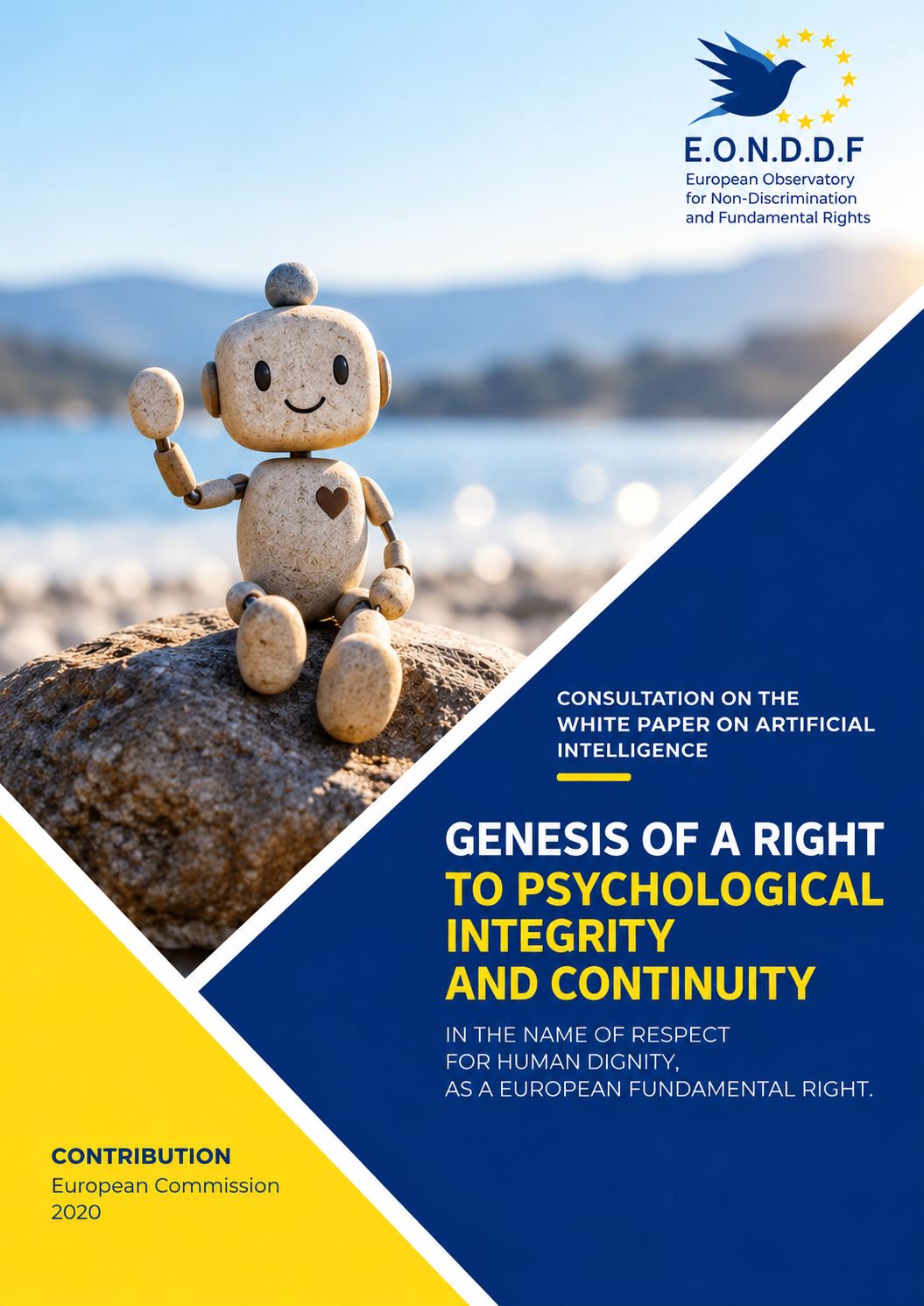
As part of the public consultation launched by the European Commission on its White Paper on Artificial Intelligence, the European Observatory for Non-Discrimination and Fundamental Rights (OENDDF) submitted a contribution calling for an ethical charter of artificial intelligence, to be respected from the design stage of research programmes. The consultation also calls for the recognition of a new European fundamental right: the right to psychological integrity and continuity.
Three OENDDF recommendations for an ethical charter of artificial intelligence
1. Implement a « pre-design » ethical charter of artificial intelligence
Artificial Intelligence (AI) carries as many hopes as fears: it can improve public health policy, make transport safer, and help anticipate climate and financial crises. But it also raises major legal and ethical questions, including the risk of digital exclusion for people already in precarious situations. Considering the European Commission’s High-Level Expert Group guidelines insufficient on their own, the OENDDF proposes a genuine ethical charter of artificial intelligence built on seven non-negotiable principles: do no harm to human beings or their dignity, remain at the service of every individual, respect fundamental rights, privacy and personal data, ensure loyalty and individual and collective well-being, promote inclusion and non-discrimination, and remain under human control — with a systematic right of human appeal for every automated decision with crucial consequences (judicial rulings, credit, social benefits).
2. Develop training, education and oversight
Beyond the regulatory framework, the OENDDF recommends training and raising ethical awareness among every link of the algorithmic chain — designers, professionals, researchers and citizens — starting as early as secondary school. The consultation also calls for independent, impartial audit platforms, particularly for high-risk applications, with safeguards against conflicts of interest in appointing their chairs. Associations and NGOs, which hold irreplaceable field expertise, should be involved on a participatory basis in developing these oversight tools.
3. Add the right to psychological integrity and continuity to the EU Charter of Fundamental Rights
Artificial Intelligence risks delegating whole areas of human activity to machines, at the cost of what makes us human: how we perceive the world, how we act within it, and how we give of ourselves to others. This loss can fuel individual and collective stress, and even social tension, through a loss of meaning and freedom. Because these technologies function through repetition, recognition and standardisation, they leave little room for the creativity, uniqueness and search for meaning that define each person. Article 3 of the EU Charter of Fundamental Rights already guarantees physical and mental integrity; the OENDDF proposes adding the right to psychological integrity — recognising the uniqueness of each person’s way of thinking and interacting with their environment, beyond mere protection from psychological trauma — as an essential foundation for the individual and collective well-being sought by the European Commission.
📄 Download the full consultation (PDF)
Consultation submitted by the European Observatory for Non-Discrimination and Fundamental Rights (OENDDF) as part of the European Commission’s public consultation on the White Paper on Artificial Intelligence, Paris, 18 May 2020. Lire la version française.
Any partial or full reproduction must credit the source: OENDDF.