
The European Solidarity Corps: OENDDF Contribution (2017)
— OENDDF contribution to the European Commission’s public consultation, by Christine Monty, President of the OENDDF
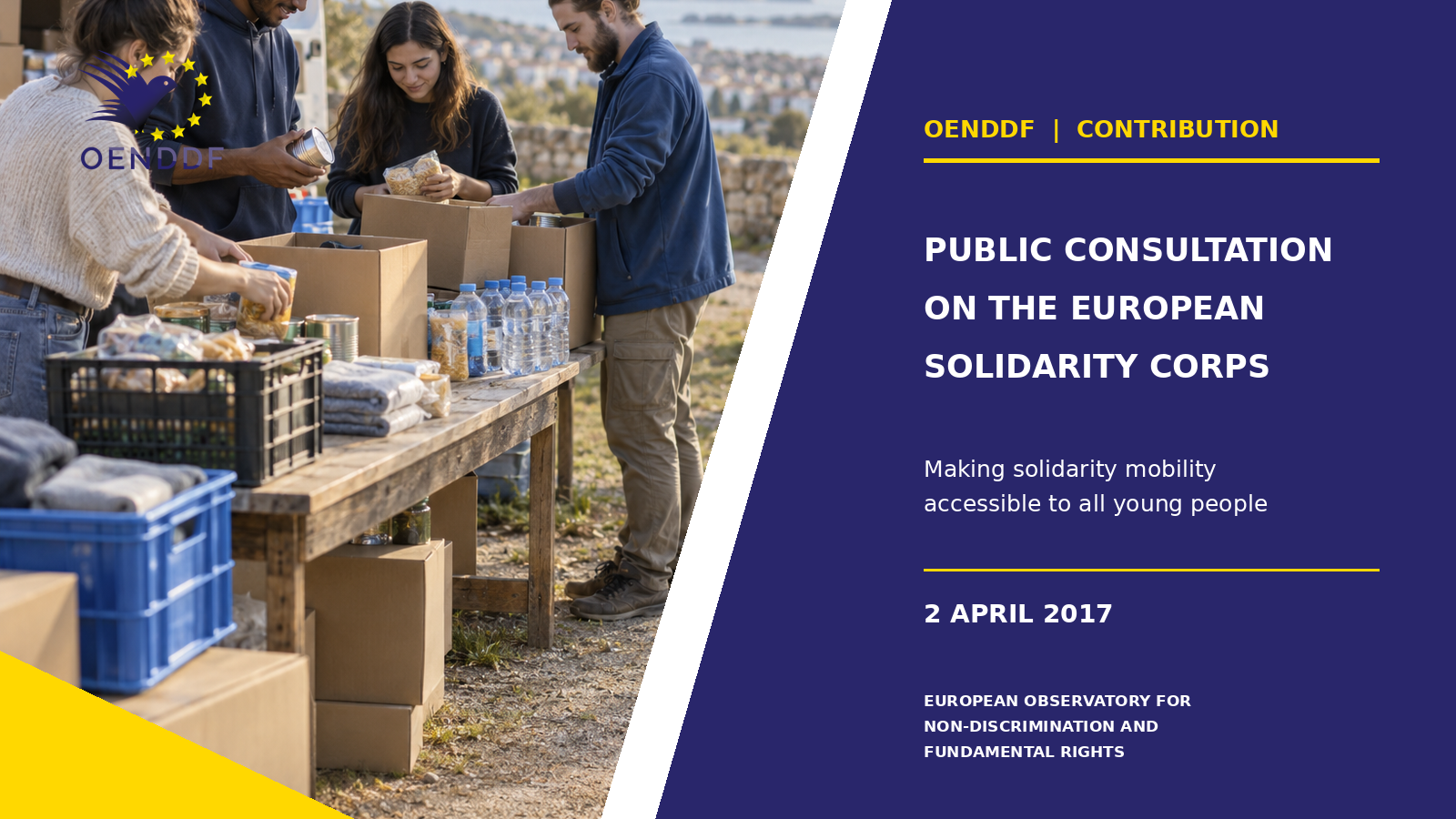
From 6 February to 2 April 2017, the European Commission held a public consultation on the European Solidarity Corps, then still in its initial phase. The consultation followed an initial phase of targeted discussions conducted at the end of 2016, and sought the views of young people, organisations and other stakeholders on the priorities of the future initiative, its accessibility, the forms of engagement proposed and its implementation arrangements. The OENDDF submitted its contribution on 2 April 2017, focusing primarily on access for disadvantaged young people and those with specific needs, the value of educational support, and the need to prioritise adaptability over formal qualifications alone.
The results of the consultation informed the legislative proposal presented by the European Commission on 30 May 2017, and were summarised in Staff Working Document SWD(2017) 166.
Priorities for the European Solidarity Corps
The OENDDF considers that the European Solidarity Corps should first enable young people to put solidarity into practice, create opportunities for cross-border mobility and allow them to develop their skills and competences. The programme should not select only young people who already possess the cultural familiarity, qualifications or experience needed to operate easily in an international environment: it should also open European mobility to those who have never travelled, do not necessarily speak a foreign language or have no previous professional experience.
Making the programme accessible to the most vulnerable young people
Access for young people from disadvantaged backgrounds or with specific needs requires suitable arrangements: additional allowances and training, shorter placements, part-time activities. For the most vulnerable young people, the OENDDF recommends enhanced human support — in certain situations, a youth worker from the participant’s country of origin should be able to accompany the young person, help them adjust to a foreign environment and provide continuity and security throughout the placement.
An inspiring practice
The French association « Channel », which supports young people undergoing social reintegration, organises volunteering and solidarity activities with migrants in Calais, in cooperation with the local organisation L’Auberge des Migrants. It was preparing a new activity in London in which two youth workers would accompany six young people whom they knew well and supported throughout the year — a reassuring presence for participants, some of whom were too vulnerable to face a new environment alone.
OENDDF recommendations
- Provide enhanced human support for disadvantaged young people and those with specific needs, including the possibility of being accompanied by a youth worker from their country of origin;
- Offer flexible formats through shorter placements, part-time activities and appropriate financial support;
- Ensure that qualifications or international experience are not decisive criteria, and value interpersonal skills, flexibility and adaptability;
- Prepare each participant for the practical tasks of the project in order to facilitate their integration into the host organisation;
- Simplify accreditation, funding and registration so that young people and organisations can participate effectively in the initiative;
- Sustain the European solidarity community through shared platforms and activities for former participants.
For the OENDDF, the European Solidarity Corps fully achieves its purpose when it enables young people who would not ordinarily have access to such opportunities to experience mobility, develop their skills and contribute to an activity that benefits society. Educational attainment, proficiency in a foreign language or a lack of international experience should not constitute barriers to participation.
Download the full contribution (English version, PDF):
Frequently Asked Questions
What was the European Solidarity Corps and when did this consultation take place?
The European Solidarity Corps was then in its initial phase, with a volunteering strand and an occupational strand (jobs, traineeships, apprenticeships), open to young people from the age of 17 (a placement could only begin at 18). The European Commission held a public consultation from 6 February to 2 April 2017, to which the OENDDF responded on 2 April 2017.
What does the OENDDF recommend to make the scheme accessible to the most vulnerable young people?
The OENDDF recommends enhanced human support (including a youth worker from the participant’s country of origin), flexible formats (shorter placements, part-time activities, appropriate financial support), and selection based on adaptability rather than qualifications or international experience.
What follow-up was given to this consultation?
The results of the consultation informed the legislative proposal presented by the European Commission on 30 May 2017, and were summarised in Staff Working Document SWD(2017) 166, covering the consultations conducted between January and April 2017.
Contribution submitted by the European Observatory for Non-Discrimination and Fundamental Rights (OENDDF) to the European Commission’s public consultation on the European Solidarity Corps, on 2 April 2017. Lire la version française.
Any partial or full reproduction must credit the source: OENDDF.